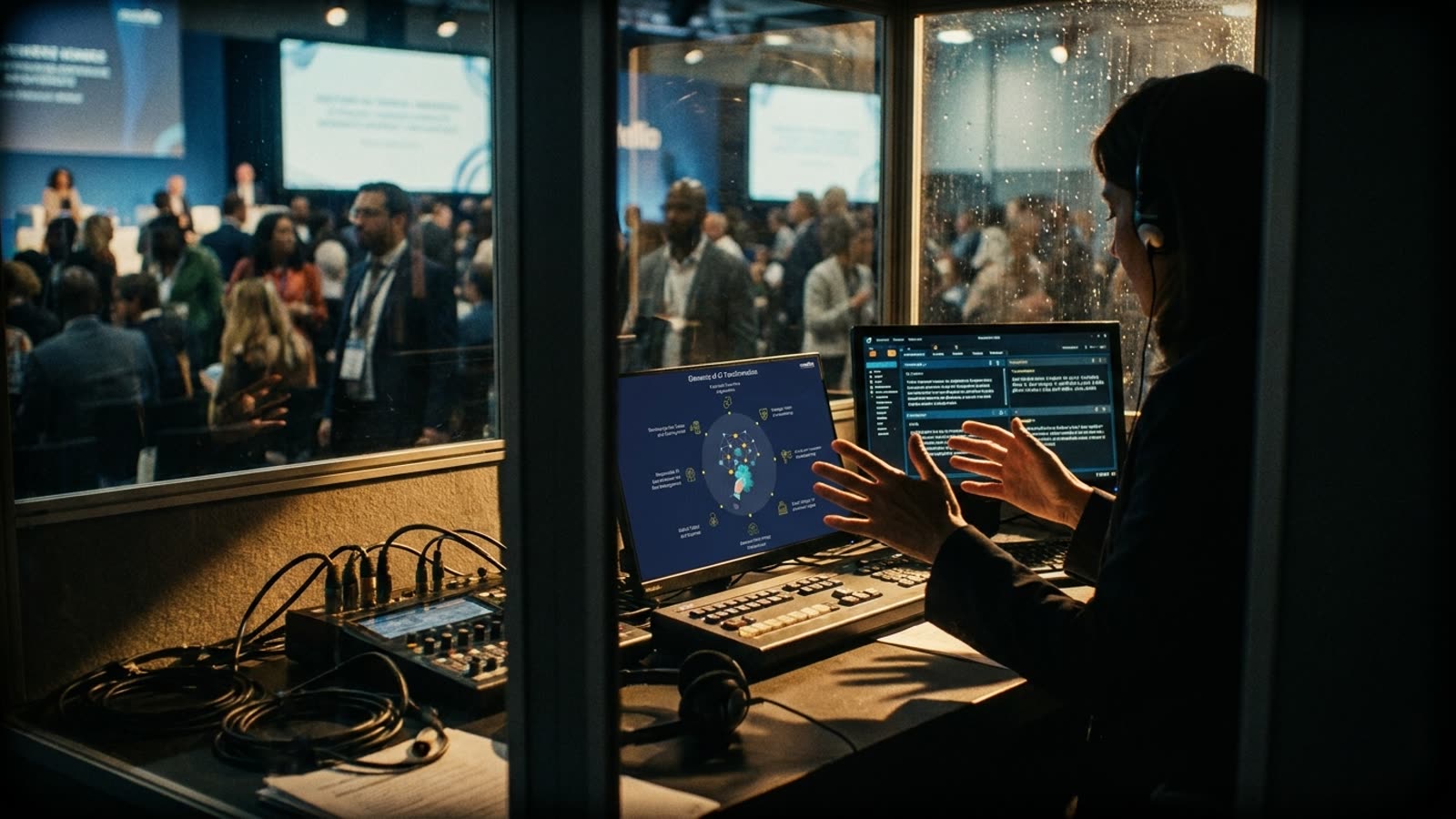
The simultaneous interpreter used to be the closest thing diplomacy had to an athlete. Sitting in a glass booth at the United Nations or the European Parliament, they would listen in one language while speaking in another, their brains performing a cognitive feat so demanding that shifts rarely exceeded thirty minutes before exhaustion set in. The job required not just fluency but a particular kind of mental architecture—the ability to hold meaning in suspension while reformulating it in real time, all while the next sentence was already arriving.
Neural machine translation did not eliminate this work. It did something more disorienting: it made the work unrecognizable.
The new workflow
Today's professional interpreter increasingly operates in what the industry calls "post-editing" mode. The AI produces a first-pass translation in milliseconds; the human reviews, corrects, and polishes. For routine business meetings, legal depositions, and medical consultations, this hybrid approach has become standard. The interpreter's value has shifted from raw production to judgment—knowing when the machine has missed a cultural nuance, botched an idiom, or produced something grammatically correct but pragmatically wrong.
The economics followed predictably. Rates for straightforward interpretation work have compressed. But specialists who handle high-stakes negotiations, literary translation, or languages with limited training data command premiums that would have seemed absurd a decade ago. The market has bifurcated: commodity work at commodity prices, and bespoke work at bespoke rates.
What the machines still miss
The gaps are instructive. Neural translation excels at pattern matching across vast corpora, which means it handles common language pairs and standard registers beautifully. It struggles with code-switching—the way a Mexican-American lawyer might slip between English and Spanish mid-sentence to signal solidarity with a client. It misses the deliberate ambiguity that diplomats deploy when they want to say something without quite saying it. It cannot read the room.
More subtly, AI translation tends toward the mean. It produces competent, unremarkable prose because that is what its training data rewards. Human interpreters at the top of the profession do something different: they preserve voice. When a French president speaks with a particular rhetorical flourish, the best interpreters render not just the meaning but the music. This is not a skill machines are close to replicating.
The training pipeline problem
Language programs at universities have noticed something troubling. Applications to interpretation programs have declined, as prospective students reasonably wonder whether they are training for a disappearing profession. But the profession is not disappearing—it is becoming more selective. The interpreters who will thrive are those comfortable working alongside AI tools, capable of rapid quality assessment, and specialized enough to handle what automation cannot. The pedagogical challenge is teaching students to be better than a machine rather than merely as good as one.
Our take
The AI transformation of interpretation offers a template for how many knowledge professions will evolve. The middle falls out. Routine work gets automated; premium work gets more premium. The survivors are not those who resist the tools but those who develop the judgment to know when the tools are wrong. For interpreters, that judgment is built on the same foundation it always was—deep cultural knowledge, situational awareness, and an ear for what language is actually doing beneath its surface meaning. The booth is quieter now. The cognitive demands are different. But the humans who remain are not redundant; they are referees.