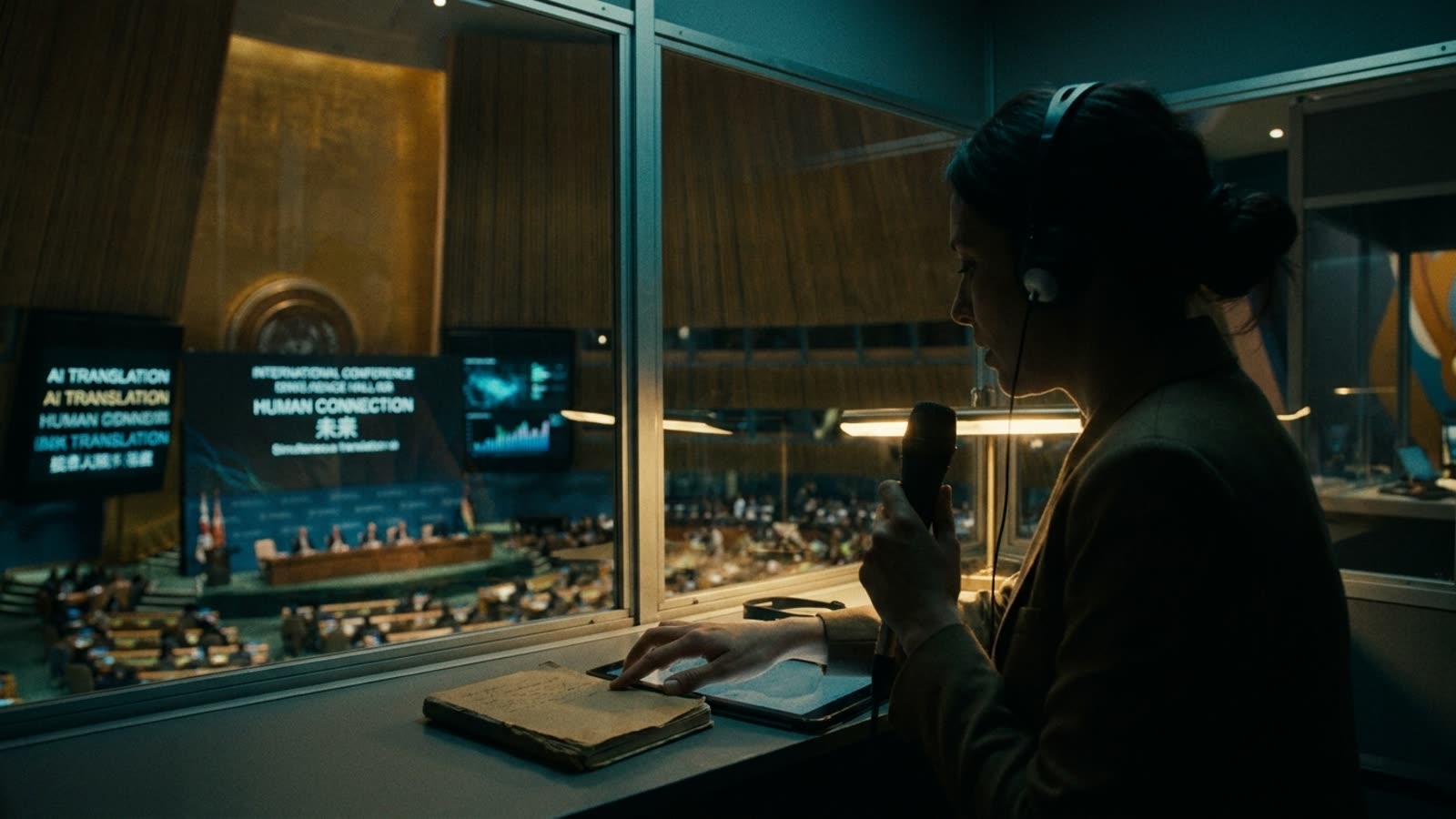
The simultaneous interpreter sitting in the glass booth at the United Nations does something no large language model can replicate: she reads the room. When the Kenyan delegate pauses mid-sentence, shifting his weight, she knows he is about to reverse his position. When the French ambassador's voice drops half a register, she conveys not just his words but his barely concealed fury. The machine hears audio. She hears politics.
This distinction—between processing language and understanding communication—is reshaping one of humanity's oldest professions. Translation and interpretation, once the exclusive province of polyglots with exceptional memories, now exists in uneasy partnership with AI systems that can render text between languages with startling fluency. The question facing the field is not whether machines will replace humans, but what exactly humans will become.
The capability gap narrows, then doesn't
Neural machine translation has made genuinely remarkable progress. Systems trained on billions of sentence pairs can now produce output that, for straightforward documents, reads naturally and accurately. A business contract, a product manual, a news article—these can be machine-translated today with results that would have seemed miraculous fifteen years ago.
But the gap stops narrowing at a curious threshold. When context becomes ambiguous, when cultural knowledge matters, when the speaker's intent diverges from their literal words, machines stumble in ways that reveal their fundamental architecture. They predict likely next tokens. They do not understand why someone might say the opposite of what they mean, or leave the most important thing unsaid entirely.
Professional interpreters report a consistent pattern: clients initially assume AI will handle everything, then discover the hard way that certain situations demand human judgment. A merger negotiation where trust is fragile. A medical consultation where the patient's culture shapes what symptoms they will admit to. A diplomatic exchange where deliberate ambiguity serves both parties.
The new specializations
What emerges is not replacement but stratification. Routine translation work—the bulk of the market by volume—increasingly flows through machine systems with light human post-editing. This has compressed rates for commodity work and eliminated many entry-level positions that once trained the next generation.
But at the upper end, demand for elite interpreters has intensified. Their role has evolved from linguistic conduit to cultural advisor, communication strategist, and real-time analyst. They are hired not merely to convert words but to explain why the Japanese executive keeps saying yes while meaning no, or why the Brazilian negotiator's warmth signals professional distance rather than friendship.
Some interpreters have pivoted to training AI systems, leveraging their expertise to improve machine output. Others specialize in post-editing, cleaning machine translations with efficiency no monolingual editor could match. A few have built consulting practices around what might be called meta-communication: advising organizations on how to structure multilingual interactions so that meaning survives the journey between languages, whether the translator is human or artificial.
The training paradox
The profession faces a genuine structural problem. Mastery requires thousands of hours of practice, traditionally gained through lower-stakes assignments that machines now handle. If the entry-level work disappears, where do future experts come from?
Interpretation schools report shifting curricula. Less emphasis on raw vocabulary acquisition—machines handle that adequately—and more on cultural competence, subject-matter expertise, and the soft skills that make a human interpreter irreplaceable in high-stakes settings. The interpreter of the future may need fewer languages but deeper knowledge of the domains where she works.
Our take
The story of AI and interpretation is not a tragedy of displacement but a case study in professional evolution. The interpreters who thrive will be those who recognize that their value was never really about knowing two languages. It was about understanding two worlds—and helping them speak to each other in ways that machines, for all their fluency, cannot fathom. The glass booth at the UN will have an occupant for a long time yet. She will simply be doing a different job than her predecessors imagined.