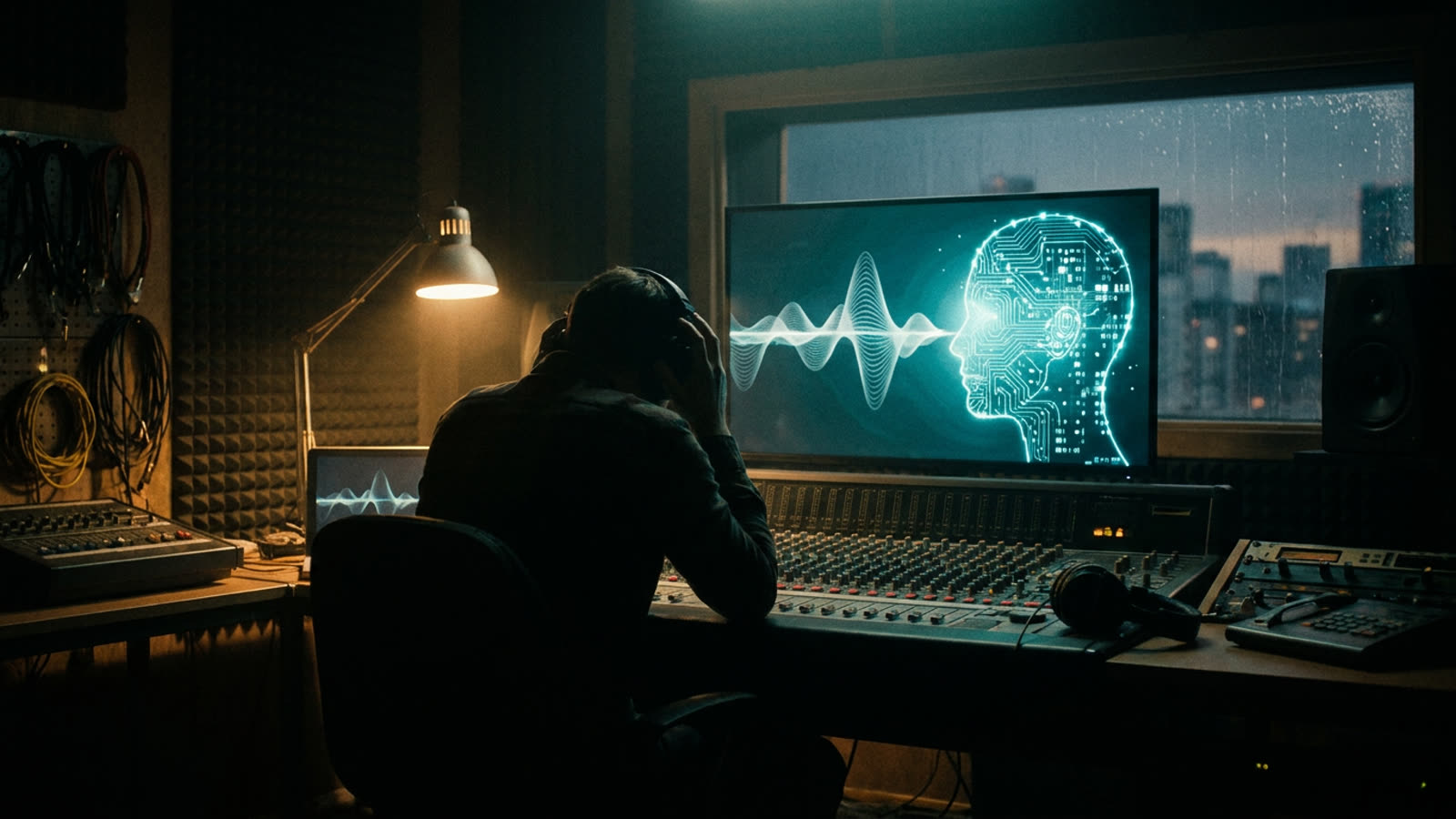
For most of the twentieth century, voice acting was a guild of anonymity. The people behind cartoon characters, audiobook narrations, and telephone prompts worked in padded rooms, earning residuals and repeat bookings through the irreducible particularity of their instrument. A voice, unlike a face, could not be digitally composited or enhanced. It was, in the truest sense, embodied labor.
That premise is now under sustained assault. Synthetic voice technology has progressed from robotic text-to-speech to something far more unsettling: voices that breathe, hesitate, and emote with convincing naturalism. The implications ripple through every corner of the industry, from video game studios to corporate e-learning departments, and the conversation has moved well past hypotheticals.
The economics of infinite takes
The traditional voice session is an expensive proposition. Studio time, talent fees, direction, retakes, union minimums, and residual structures all compound. A thirty-second commercial spot can cost thousands; an audiobook, tens of thousands. Synthetic voice collapses this calculus. Once a voice model is trained—whether on licensed recordings or, more controversially, scraped audio—it can generate unlimited output at marginal cost approaching zero.
For clients with high-volume, low-stakes audio needs, the appeal is obvious. Corporate training modules, app notifications, GPS navigation, and automated customer service have already shifted heavily toward synthetic voices. The quality threshold for these applications is utility, not artistry, and AI clears it comfortably.
Where the human remains essential
The more interesting question is where synthesis fails. Premium audiobook narration, character work in prestige animation, and advertising that trades on authenticity still demand human performers. The reason is not merely technical. Listeners form parasocial relationships with narrators; audiences detect something ineffable in a performance that emerges from lived experience rather than statistical inference.
Yet even these strongholds face pressure. Studios have begun using AI to generate scratch tracks and temp performances, then hiring human talent only for final delivery—or, in some cases, to "polish" synthetic output. The line between tool and replacement blurs when the tool does ninety percent of the work.
The consent problem
The most fraught territory involves voice cloning without explicit permission. Several high-profile disputes have emerged over models trained on actors' existing recordings, sometimes producing work the original performer never agreed to. Union contracts have scrambled to address the gap, but enforcement remains uneven, particularly across jurisdictions. A voice, unlike a copyrighted script, has historically enjoyed only limited legal protection—a gap that synthetic replication exploits ruthlessly.
Our take
Voice acting will not vanish, but it will stratify. A small tier of elite performers will command premiums precisely because their humanity is verifiable and valued. Below them, a vast middle class of working voice actors faces displacement by technology that can approximate their output at a fraction of the cost. The industry's future likely resembles that of commercial illustration post-stock-photography: fewer practitioners, higher barriers to entry, and a lingering question about what, exactly, we lose when we optimize for efficiency over presence. The booth may survive. The guild, as it existed, probably will not.