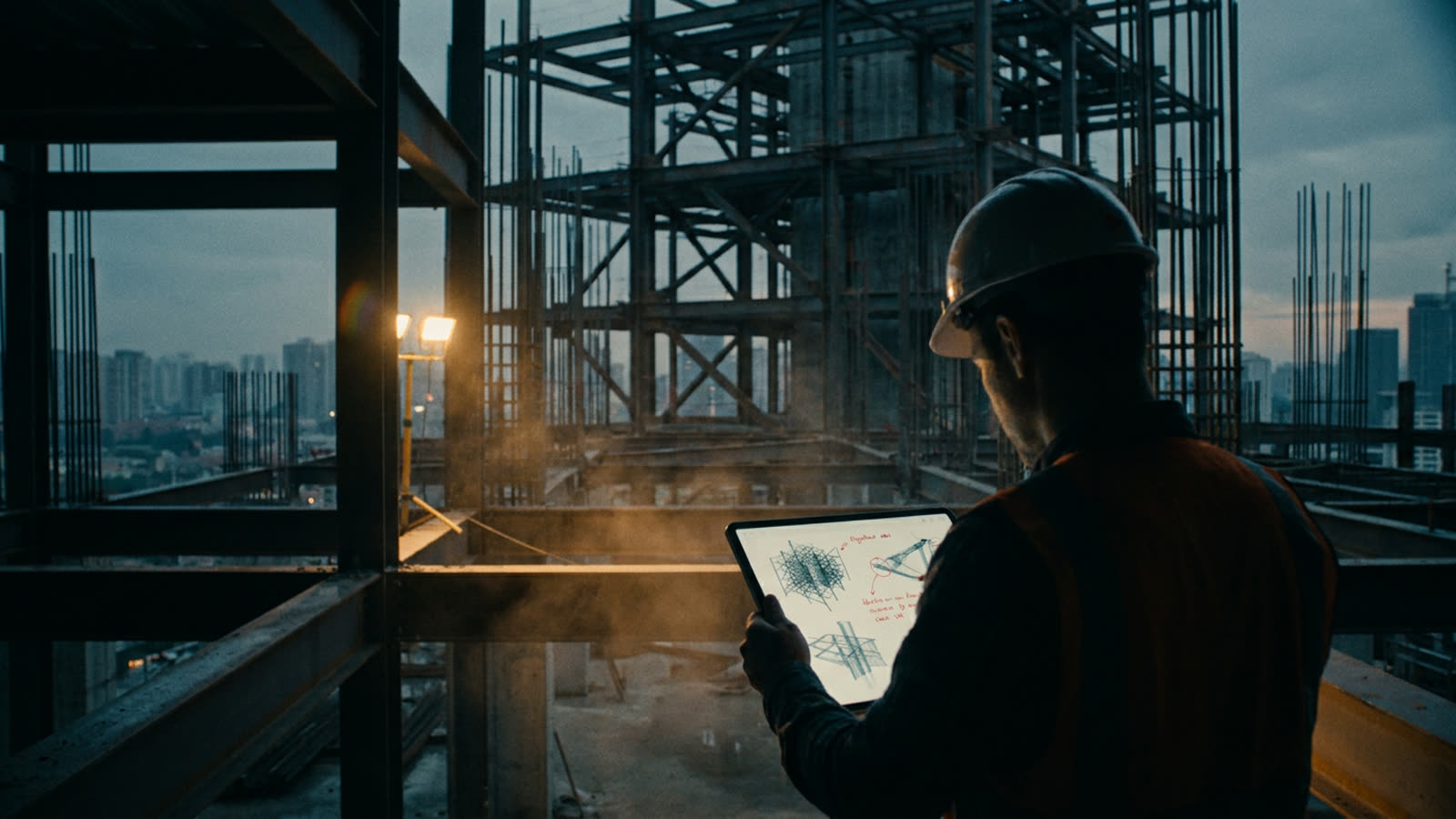
When a structural engineer signs off on a building, they are making a promise measured in decades. The steel skeleton holding up an office tower, the concrete frame of a hospital, the timber lattice of a concert hall — these must stand through earthquakes, hurricanes, and the slow accumulation of human use. It is a profession built on conservatism, redundancy, and the hard-won intuition that comes from understanding why structures have failed in the past.
Now that intuition is being challenged by software that proposes geometries no human would have conceived.
The generative turn
Generative design tools have existed in some form for years, but recent advances in optimization algorithms and computational power have made them genuinely useful for structural work. Feed the software a set of constraints — maximum weight, minimum stiffness, allowable materials, connection points — and it will iterate through thousands of possible configurations, converging on forms that satisfy the requirements with startling efficiency.
The results often look organic, almost biological: branching columns that distribute load like tree trunks, floor plates with irregular voids that reduce material without sacrificing strength. They are mathematically defensible but visually alien. And therein lies the tension.
Structural engineering has always relied on what practitioners call "engineering judgment" — the capacity to look at a design and sense whether it will behave as expected. This judgment is trained over years of education and practice, rooted in familiar typologies: the portal frame, the moment-resisting frame, the braced core. When software produces a form that resembles none of these, the engineer faces a choice: trust the math, or trust the gut.
The liability question
Unlike professions where AI errors are embarrassing but recoverable, structural engineering operates under a regime of absolute consequence. A hallucinated citation in a legal brief can be corrected; a miscalculated beam cannot be recalled after the concrete has cured. This asymmetry shapes how the profession is absorbing new tools.
Many firms now use AI-assisted optimization during early design phases, then hand the output to senior engineers who verify every load path manually. The machine proposes; the human disposes. It is a workflow that captures efficiency gains while preserving the chain of professional responsibility that building codes and insurance policies require.
But this hybrid approach raises its own questions. If an engineer approves a computer-generated design they do not fully understand, have they fulfilled their professional duty? Licensing boards in several jurisdictions are beginning to grapple with this, though clear guidance remains scarce.
What the machines still miss
For all their optimization prowess, current AI tools struggle with the messiest parts of structural work. They cannot easily account for construction sequencing — the fact that a building is erected piece by piece, and temporary conditions during assembly may be more dangerous than the final state. They have limited capacity to model long-term material behavior: creep in concrete, fatigue in steel, the slow decay of connections exposed to weather.
Most critically, they cannot yet incorporate the tacit knowledge that experienced engineers bring to site visits. The crack that looks benign but suggests foundation movement. The rust stain that indicates water infiltration. The subtle deflection visible only in certain light. These observations, unglamorous and difficult to quantify, remain stubbornly human.
Our take
The structural engineering profession is doing something admirable: absorbing powerful new tools without abandoning the conservatism that keeps buildings standing. The engineers who will thrive are those who learn to interrogate algorithmic proposals with the same skepticism they would apply to a junior colleague's first draft — demanding explanations, probing assumptions, trusting but verifying. The machines are getting better at finding optimal solutions. The humans remain essential for asking whether the problem was correctly defined in the first place.