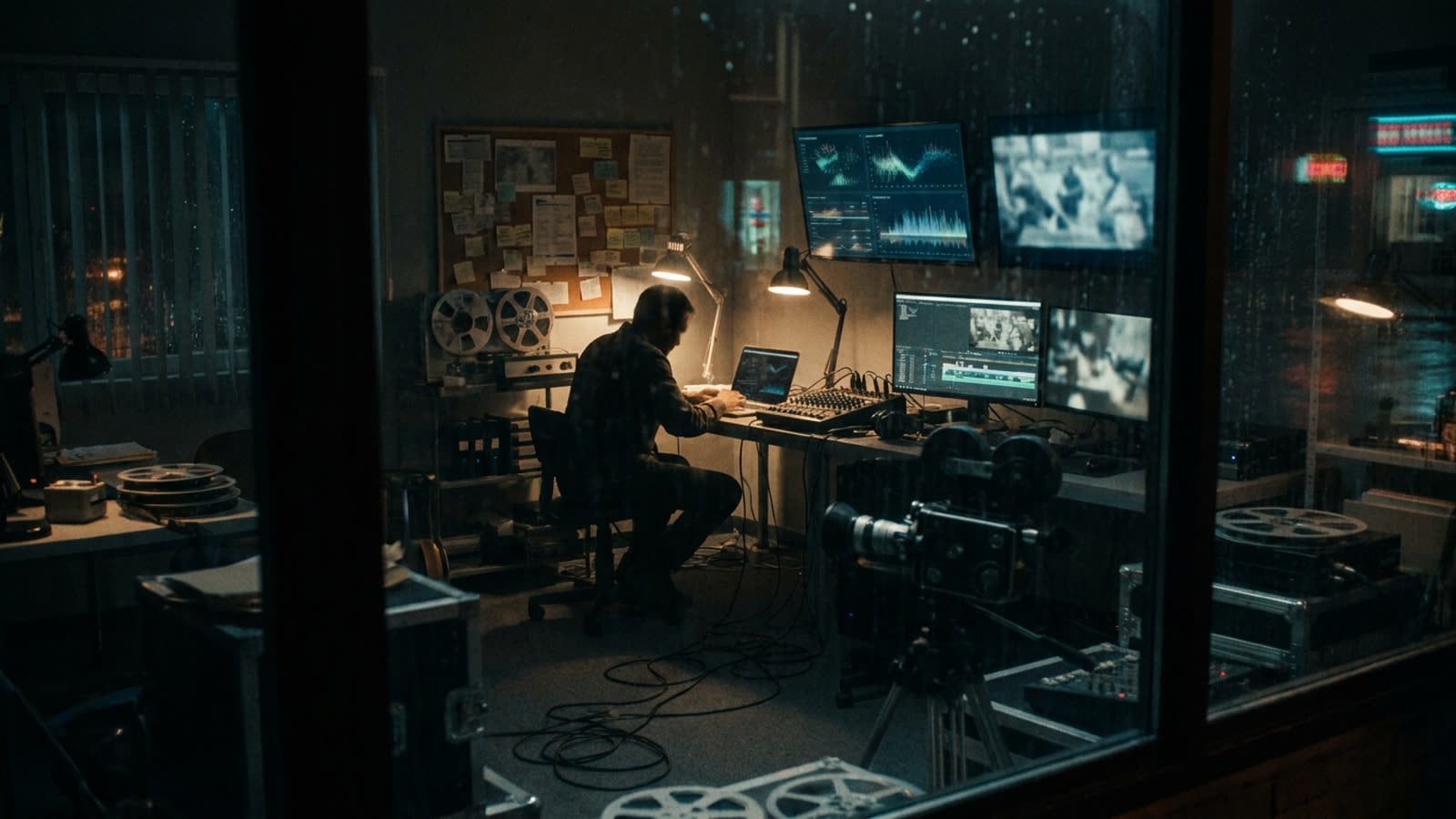
Documentary film has always been a lie agreed upon. The camera frames, the editor sequences, the director chooses what to include and what to leave on the cutting room floor. But the fundamental promise—that what you see actually happened, that real people said those words in real spaces—has remained the genre's sacred contract with audiences. Artificial intelligence is now testing that contract in ways that feel genuinely unprecedented.
The infiltration began quietly. Transcription services powered by speech recognition made logging footage faster. Facial recognition helped archival researchers locate subjects across decades of material. These felt like productivity tools, no different from the Steenbeck giving way to Avid. But the current generation of AI capabilities has pushed into territory that touches the documentary's epistemological core.
The assembly cut gets automated
Consider the rough cut, traditionally the most labor-intensive phase of documentary production. Editors spend weeks, sometimes months, watching hundreds of hours of footage, tagging moments, building selects reels, intuiting which fragments might eventually speak to each other. AI-powered editing assistants can now ingest that same footage and generate assembly cuts in hours, clustering material by theme, emotion, or narrative arc based on transcript analysis and visual recognition.
The efficiency gains are real. Independent documentarians working without studio budgets report that these tools have made previously impossible projects feasible. A solo filmmaker can now process the kind of footage volume that once required a team. The question is what gets lost when the initial curatorial act—the slow, patient watching that shapes a documentarian's relationship with their material—gets outsourced to pattern recognition.
The interview that never happened
More troubling applications lurk at the edges. Voice synthesis can now clone a subject's speech patterns with sufficient training data. A documentarian could, in theory, have a deceased subject "read" newly discovered letters in their own voice. Archival footage can be upscaled, colorized, and stabilized to appear as if it were shot yesterday. Translation tools can make a subject appear to speak languages they never knew.
None of this is inherently fraudulent. Cinema has always employed artifice in service of truth. But documentary's particular power derives from the audience's belief that they are witnessing something that actually occurred. When AI enables the creation of footage that looks and sounds authentic but was generated rather than captured, the viewer's ability to trust their own perception erodes.
The disclosure problem
The industry has begun developing disclosure frameworks, but consensus remains elusive. Some festivals now require filmmakers to declare AI usage in their submissions. Broadcasters have started adding on-screen text when synthetic voices or reconstructed footage appears. These measures assume audiences will notice and process such disclosures, an assumption that decades of fine-print conditioning suggests is optimistic.
The deeper issue is that AI assistance exists on a spectrum with no obvious bright line. Is using AI transcription different from using AI to suggest edit points? Is AI-assisted color correction different from AI-generated B-roll? Documentarians who would never fabricate an interview might not think twice about using AI to clean up audio or stabilize shaky footage. The tools blur into each other, and the ethical distinctions blur with them.
Our take
Documentary has survived the transition from film to video, from linear broadcast to streaming, from theatrical to TikTok. It will survive AI too. But the form's survival depends on filmmakers and audiences agreeing on what documentary actually means in an era when the real and the synthetic become visually indistinguishable. The most honest documentaries of the coming decade may be those that foreground their own construction, that make the presence of AI tools part of the story rather than hiding them behind a veneer of authenticity. The alternative—a slow erosion of trust until audiences assume everything is manipulated—would be a loss not just for cinema but for our collective capacity to believe what we see.