Insurance underwriting has always been the art of pricing uncertainty. For centuries, this meant humans reviewing applications, consulting mortality tables, and making educated guesses about who would file claims and who would not. That world is vanishing faster than most people realize.
The transformation began not with a bang but with spreadsheets getting smarter. Machine learning models now ingest thousands of variables — from credit histories to satellite imagery of rooftops — to generate risk scores in seconds. What once took a senior underwriter days to evaluate can now be processed before a customer finishes their morning coffee. The efficiency gains are undeniable. The implications are still unfolding.
The invisible algorithm
When you apply for homeowner's insurance, there is a reasonable chance a model has already assessed your property using aerial photographs, cross-referenced local crime statistics, analyzed weather patterns for your region, and estimated the replacement cost of your roof — all before a human reviews your file. Commercial insurers increasingly use natural language processing to parse decades of claims data, identifying patterns that escaped human notice. One model might discover that businesses in certain building configurations file more water damage claims; another might correlate specific contract language with litigation frequency.
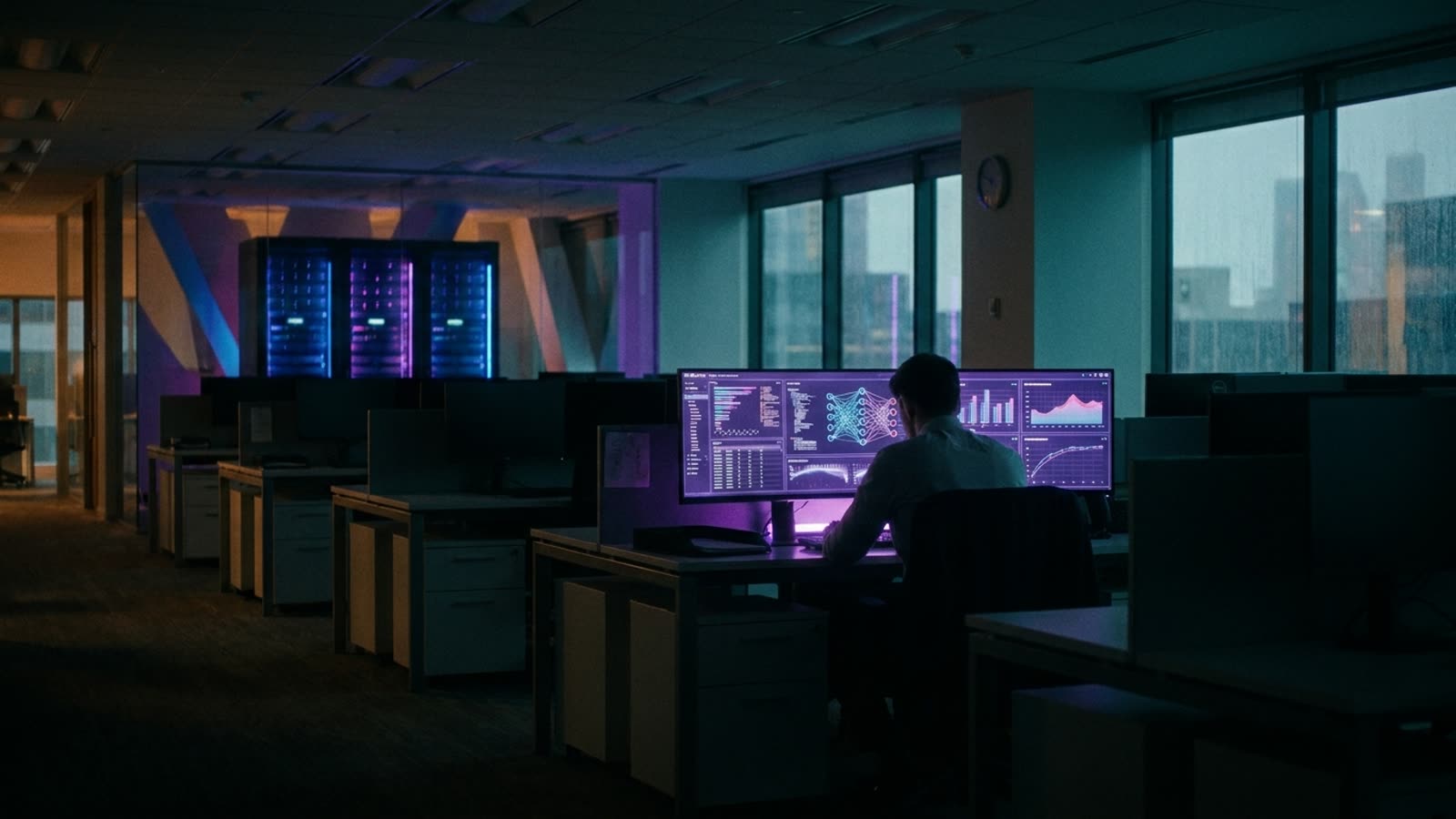
The humans have not disappeared, but their role has shifted. Underwriters increasingly function as model supervisors, reviewing edge cases the algorithms flag and calibrating systems they may not fully understand. Junior underwriters report spending more time learning to interpret model outputs than developing traditional actuarial intuition. Some veterans worry that institutional knowledge is eroding — that the next generation will know how to operate the machine without understanding why it works.
The fairness problem
Regulators have begun asking uncomfortable questions. If an algorithm denies coverage or charges higher premiums based on patterns invisible to humans, how do you audit it for discrimination? Traditional underwriting discrimination was often detectable — redlining left paper trails. Algorithmic discrimination can be subtler, emerging from correlations that serve as proxies for protected characteristics without ever naming them directly.
Insurers argue their models are more objective than human judgment, which carries its own biases. Critics counter that objectivity is not the same as fairness, and that optimizing for predictive accuracy can entrench historical inequities. The debate remains unresolved, with different jurisdictions taking different approaches. Some require algorithmic transparency; others focus on outcome testing regardless of methodology.
What the customer sees
For most policyholders, the AI revolution manifests as faster quotes and occasionally puzzling decisions. Why did the premium spike after a roof inspection? Why was one application approved instantly while another required weeks of review? The explanations offered are often generic, because the true explanations involve model weights that even the insurers' own staff may struggle to articulate.
This opacity creates a strange asymmetry. Insurers know more about their customers than ever before, while customers understand less about how their coverage is priced. Some consumer advocates have called for algorithmic explanations as a matter of right — not just the decision, but the reasoning in terms a layperson can evaluate.
Our take
Insurance underwriting was never a transparent business, but at least the old opacity was human-scale. A customer could, in theory, sit across from an underwriter and ask why. The new opacity is different in kind: decisions emerge from systems that process more information than any person could review, using methods that resist simple explanation. This is not inherently malicious — the models often are more accurate — but accuracy and accountability are different virtues. The industry has gained the former and must now figure out how to preserve the latter. The humans in the loop need to be more than button-pushers; they need to be the conscience the algorithm lacks.