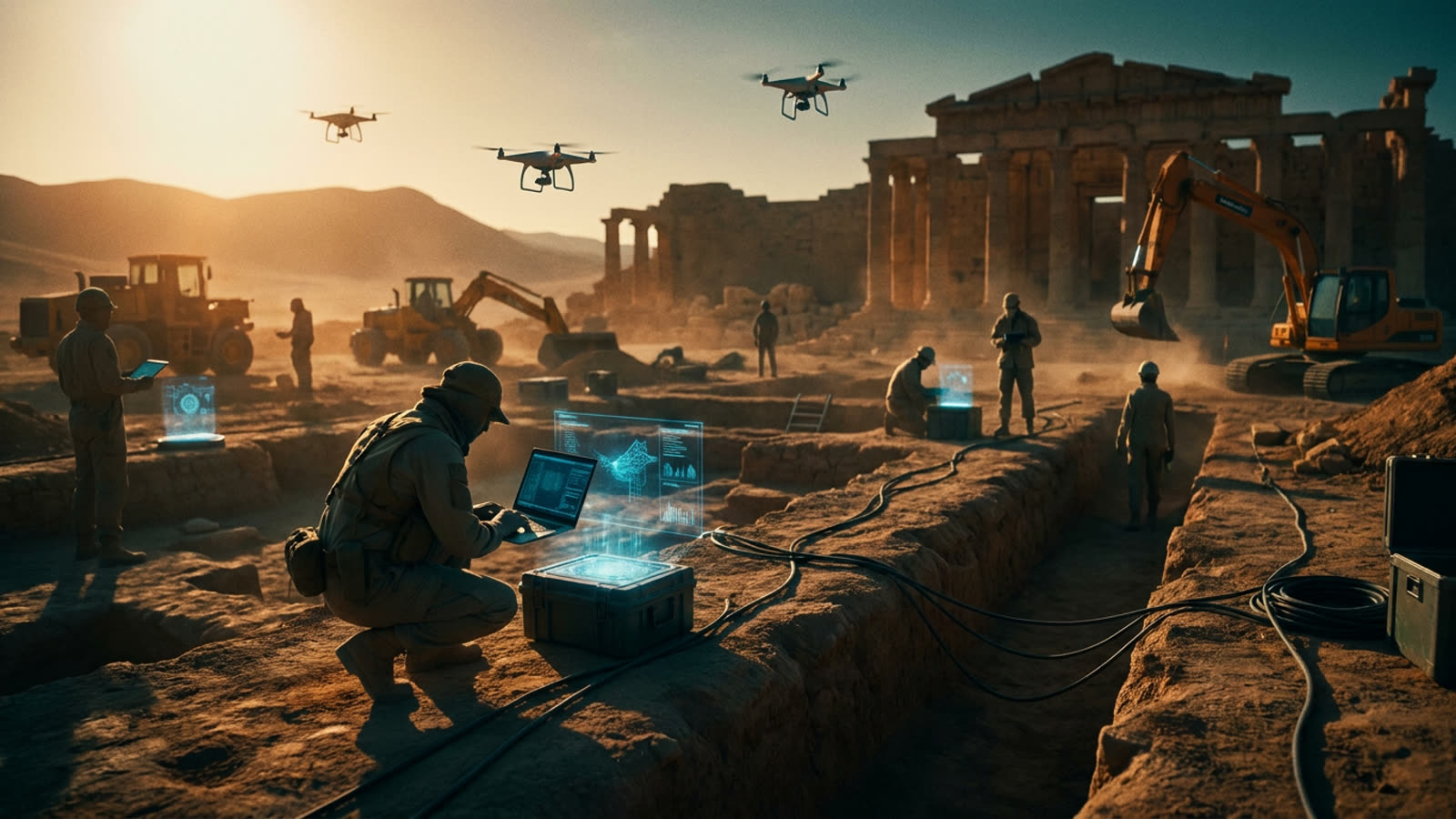
Archaeology has always been a discipline of patience. Researchers spend years excavating a single site, decades cataloguing pottery shards, entire careers piecing together fragments of text that fire or time rendered nearly illegible. The romance of the field lies precisely in this slowness — the careful brushwork, the meticulous documentation, the hard-won insights that emerge only after thousands of hours of human attention.
Artificial intelligence is now compressing that timeline in ways that would have seemed fantastical a generation ago, and the implications extend far beyond efficiency gains. The technology is changing what questions archaeologists can ask and, more fundamentally, what counts as evidence.
Reading what humans cannot
The most dramatic applications involve damaged texts. The Herculaneum scrolls, carbonised by Vesuvius in 79 AD and long considered unreadable, have begun yielding their secrets to machine-learning models trained to detect subtle density variations in CT scans. What human eyes perceive as uniform black char, algorithms recognise as distinct layers of papyrus with ink traces still intact. Similar techniques have accelerated the decipherment of cuneiform tablets, many of which sit in museum basements too fragmentary for traditional scholarship to prioritise.
The shift matters because it democratises access to the ancient world. A graduate student with the right software can now contribute to problems that once required decades of specialist training in epigraphy. Critics worry this devalues hard-won expertise; proponents counter that it frees senior scholars to focus on interpretation rather than transcription.
Seeing beneath the surface
Above ground, satellite imagery combined with machine learning has transformed survey archaeology. Algorithms trained on known site signatures can scan thousands of square kilometres of desert or jungle, flagging anomalies that suggest buried structures. Fieldwork that once required years of exploratory trenching can now be targeted with remarkable precision.
This capability arrives with ethical complications. The same technology that helps legitimate researchers locate sites also helps looters. Several countries have restricted access to high-resolution archaeological data precisely because machine-assisted treasure hunting has accelerated the destruction of unexcavated heritage.
The interpretation problem
For all its power, AI in archaeology confronts a fundamental limitation: it excels at pattern recognition but struggles with meaning. An algorithm can identify that a ceramic fragment belongs to a particular typology; it cannot explain why a community adopted that style or what social changes its appearance signals. The discipline's most important questions — about belief, identity, power, adaptation — remain stubbornly human.
Some practitioners fear a coming generation trained to trust algorithmic outputs without understanding their provenance. Others see an opportunity: if machines handle the drudgery of classification and transcription, archaeologists can devote more energy to the synthetic, interpretive work that drew them to the field.
Our take
The anxiety surrounding AI in archaeology mirrors broader cultural unease about automation displacing expertise. But the discipline's history suggests adaptation rather than obsolescence. Radiocarbon dating, aerial photography, and ground-penetrating radar each provoked similar debates in their time; each ultimately expanded the field's ambitions without rendering traditional skills irrelevant. The algorithm is not replacing the archaeologist. It is revealing how much of the past remains buried — and how much work there is still to do.