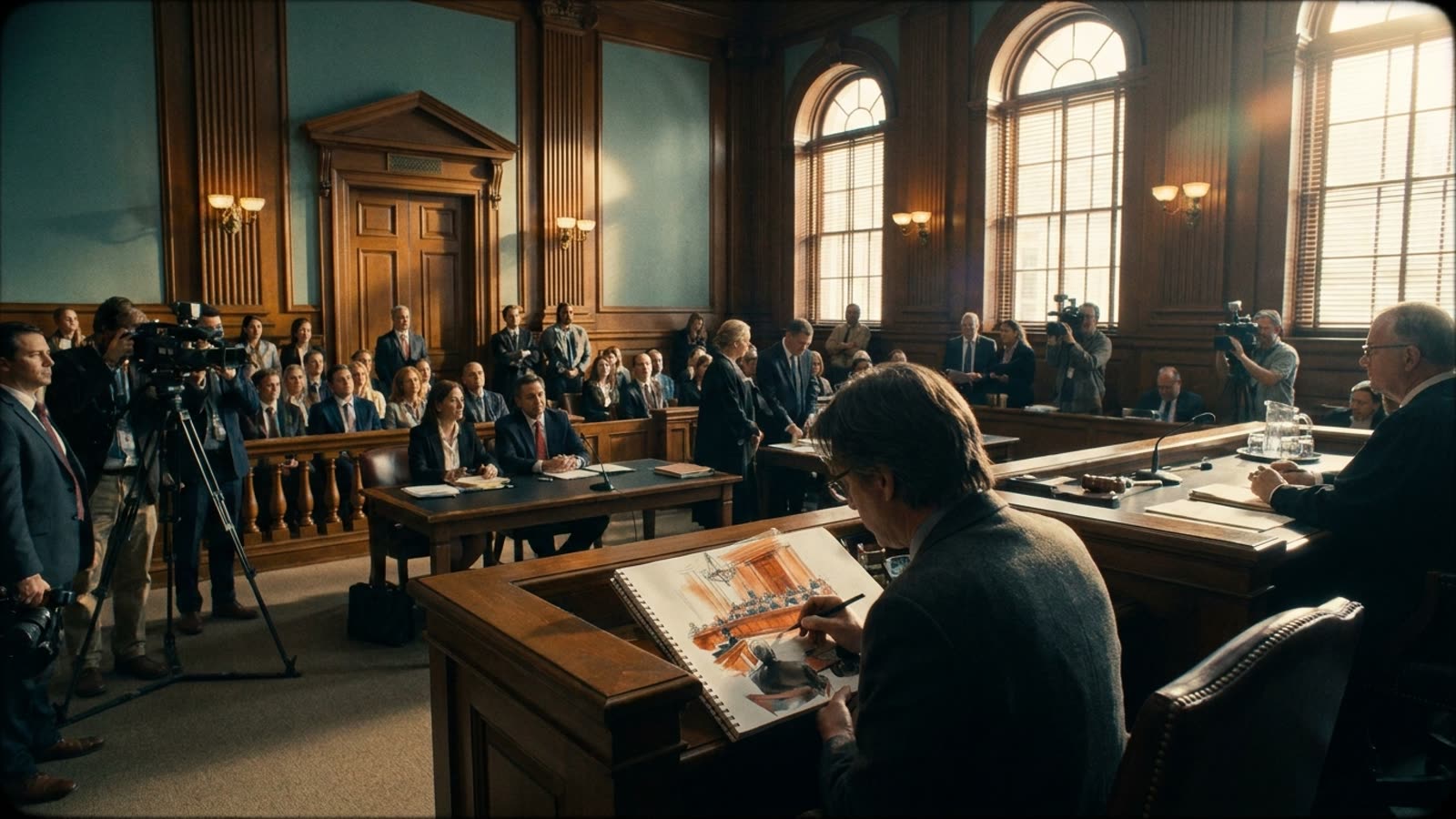
For more than a century, courtroom sketch artists have occupied one of journalism's most peculiar niches: creating visual records of trials where cameras are forbidden. They work in silence, often from awkward angles, capturing the expressions of defendants, witnesses, and judges in pastels and charcoal while history unfolds. It is a profession that should have been automated out of existence years ago. Instead, it has become a quiet case study in what AI cannot replace—and what it inadvertently preserves.
The logic for obsolescence seemed airtight. Generative image models can now produce photorealistic faces in seconds. Courts could theoretically commission AI-rendered composites of proceedings, sanitized and consistent. Some legal-tech startups have pitched exactly this. Yet the profession persists, and demand from major news organizations has remained steady. The reason illuminates something important about the limits of synthetic media.
The authentication problem
Courtroom sketches derive their authority from a specific chain of custody: a credentialed artist, present in the room, translating observed reality through trained hands. This provenance is verifiable. An editor knows who made the image, when, and under what conditions. AI-generated courtroom imagery offers no such guarantee. It can be manipulated trivially, and its training data is unknowable to the viewer. In an era of widespread synthetic media, the hand-drawn sketch has become paradoxically more trustworthy than the pixel-perfect alternative.
News organizations have noticed. Several major outlets have quietly reaffirmed policies requiring human-created courtroom art for high-profile trials, citing concerns about audience trust. The sketch artist's imperfection—the slightly off-kilter proportions, the visible strokes—now functions as a watermark of authenticity.
The interpretive value
There is also the matter of what a sketch conveys that a photograph cannot. A skilled courtroom artist makes choices: which moment to capture, which expression to emphasize, how to render the weight of a defendant's posture. These are editorial decisions, and they carry meaning. The best courtroom sketches are not neutral records but compressed narratives, communicating tension, boredom, defiance, or grief in a single frame.
AI image generators, by contrast, optimize for plausibility rather than meaning. They can produce a face that looks like it belongs in a courtroom, but they cannot decide what matters about that face in that moment. The human artist's subjectivity, once considered a liability, has become the point.
Our take
The courtroom sketch artist's survival is not a heartwarming tale of craft triumphing over technology. It is a market correction. As synthetic images become ubiquitous and untrustworthy, certain forms of human-made media acquire new value precisely because they are legibly human. The sketch artist did not adapt to AI; AI inadvertently created the conditions for their relevance. This is likely to happen in other corners of visual journalism—not because machines cannot do the work, but because audiences will increasingly demand proof that someone real did.