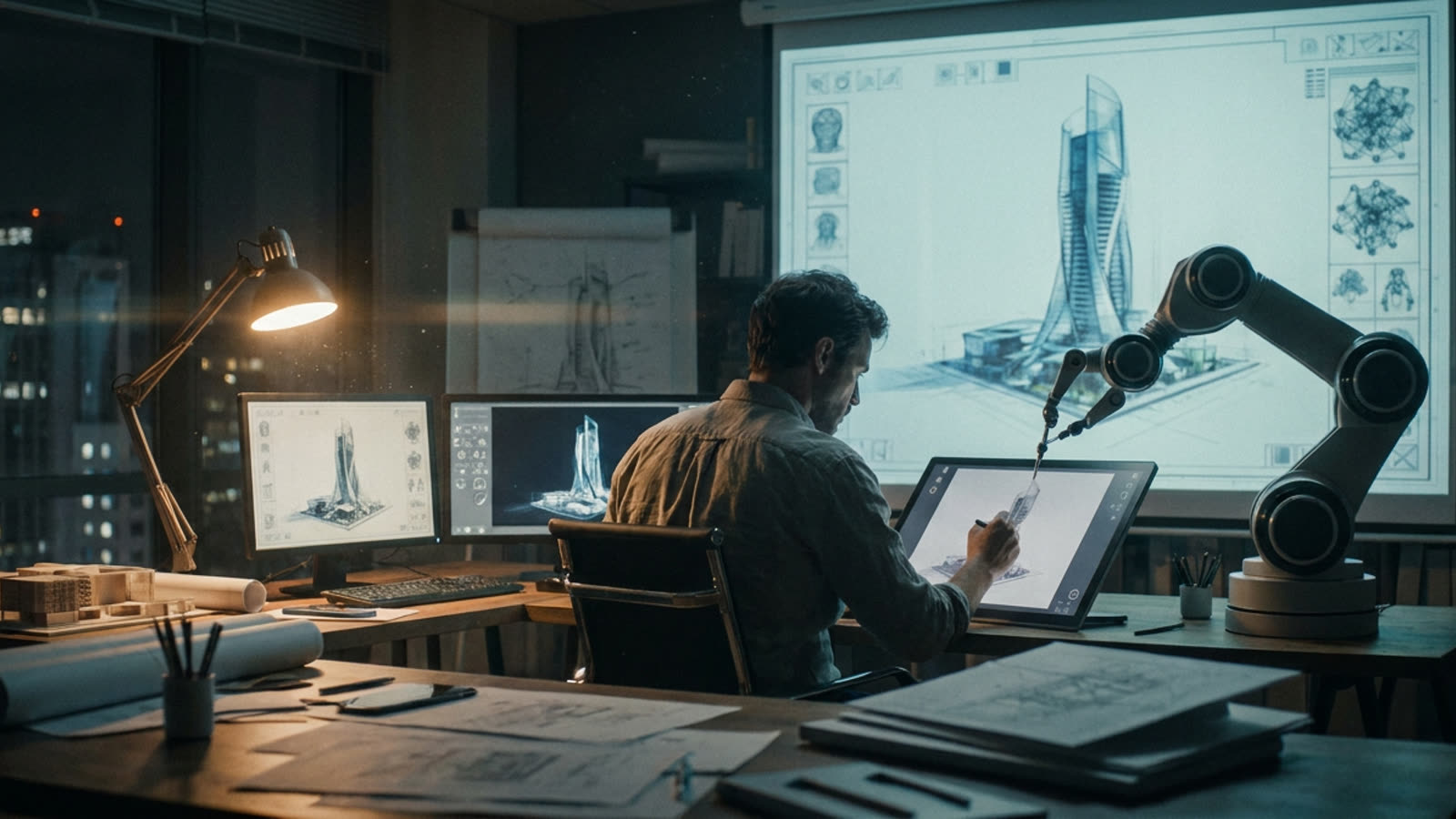
The rendering looked impossible: a concert hall whose roof seemed to fold like origami, its acoustic panels angled to bounce sound in ways no human had calculated. The architect who showed it to me had spent three hours generating it. A decade ago, that form would have required months of physical modeling and computational analysis, if anyone had thought to attempt it at all.
This is the quiet revolution underway in architecture studios from Copenhagen to São Paulo. Generative AI has infiltrated a profession that has always balanced art against engineering, and the results are forcing practitioners to reconsider what it means to design a building.
From sketch to structure
The traditional architectural process moves through distinct phases: concept sketches, schematic design, development drawings, construction documents. Each stage involves revision, client feedback, and the slow refinement of ideas. AI tools are collapsing these phases into something more fluid and unsettling.
Architects now describe prompting software the way they once described briefing junior associates. They feed constraints—site dimensions, budget parameters, sustainability targets—and receive dozens of viable forms in return. The role shifts from drawing to curating, from creating to selecting. Firms report that conceptual design phases that once consumed weeks now conclude in days.
The technology excels at optimization problems that humans solve through intuition and experience. Structural efficiency, daylight penetration, material usage—these can be calculated across thousands of variations simultaneously. The AI doesn't get attached to its first idea.
The authenticity question
Yet the profession is wrestling with a philosophical hangover. Architecture has long celebrated the singular vision: Frank Gehry's crumpled titanium, Zaha Hadid's impossible curves, Tadao Ando's concrete poetry. These signatures emerged from decades of personal exploration. What happens when anyone can generate forms of comparable complexity before lunch?
Some architects argue the tool is irrelevant to authorship—the creative act lies in knowing what to ask for and recognizing quality in the output. Others worry about homogenization, a world of buildings that all look like they were designed by the same eerily capable algorithm. Early evidence suggests both concerns have merit.
Architectural education is adapting unevenly. Some programs now teach prompt engineering alongside structural analysis. Others have banned AI from studio courses, insisting students first develop the manual skills that make machine collaboration meaningful.
The client in the loop
Perhaps the most significant shift involves the people who pay for buildings. Clients can now see realistic visualizations of their projects almost immediately, which sounds like progress until you realize it compresses decision-making in uncomfortable ways. The slow reveal of traditional design allowed ideas to mature. Instant gratification may produce faster approvals but shallower thinking.
Developers have noticed that AI-generated designs tend to cluster around certain aesthetic modes—the software has absorbed the visual language of contemporary architecture and reproduces it fluently. Breaking from that language requires architects to push against the tool rather than follow it.
Our take
The pencil was always a technology, and architects have always worked with constraints that shaped their output. AI is simply the newest constraint, and like steel framing or CAD software before it, it will produce both liberation and laziness depending on who wields it. The buildings worth caring about will still come from architects who know what they want before they start typing. The rest will be efficient, optimized, and forgettable—which, to be fair, describes most buildings that have ever been built.