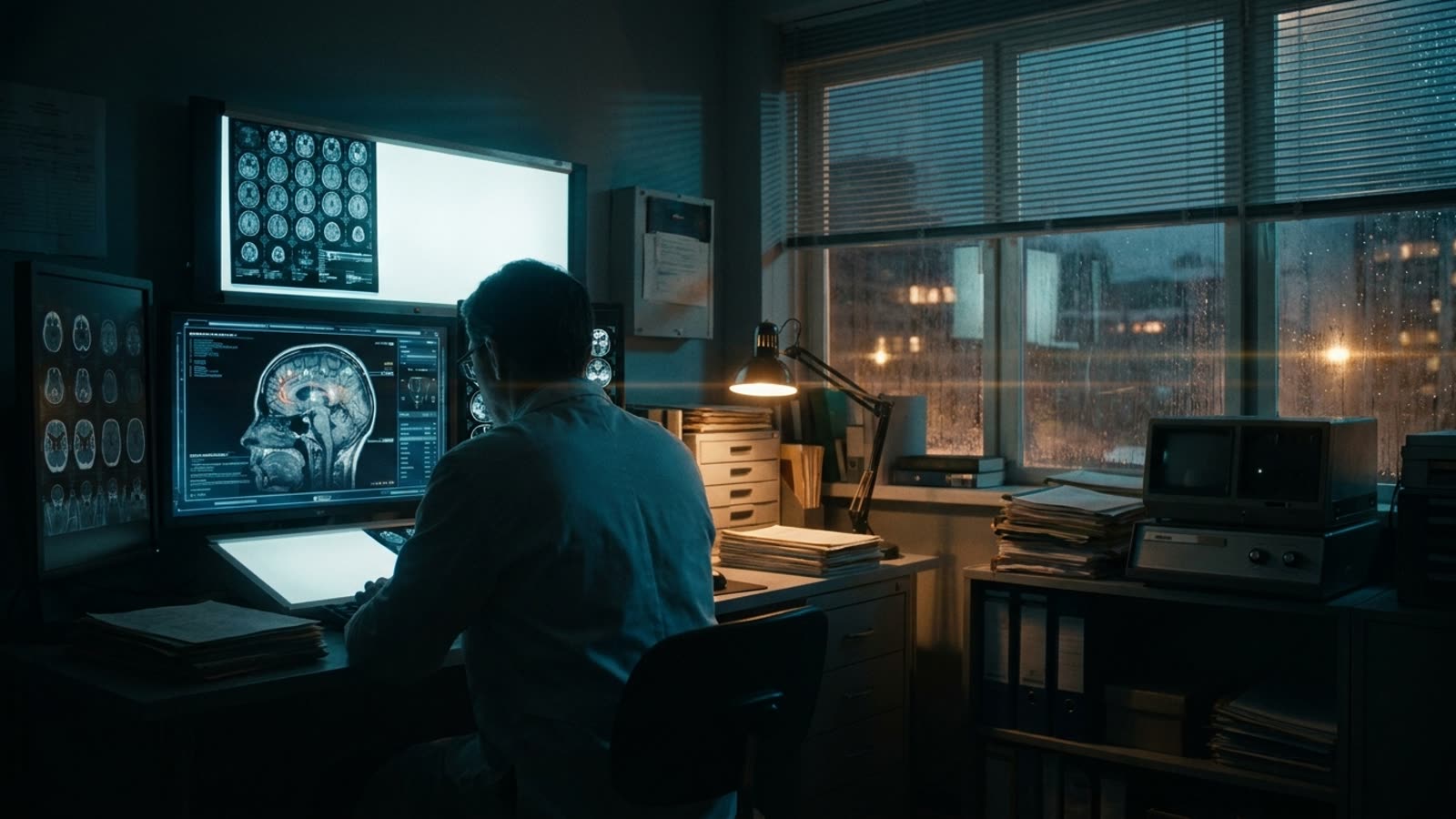
The popular imagination conjures a future in which algorithms render physicians obsolete, but the reality unfolding in hospitals worldwide is far stranger and more interesting: AI is making doctors more like doctors, not less.
The transformation is easiest to observe in radiology, where pattern recognition has always been the core skill. A radiologist examining a chest X-ray for signs of pneumonia or a mammogram for early malignancy is essentially doing what a well-trained neural network does — scanning for statistical anomalies against a mental baseline of normalcy. The difference is that the human can see perhaps fifty thousand images in a career; the algorithm has seen tens of millions.
The second reader problem
For decades, the gold standard in mammography screening has been double reading — two radiologists examining the same scan independently, then reconciling disagreements. The practice catches more cancers but is expensive, slow, and impossible in health systems already short on specialists. AI now functions as that second reader in a growing number of European screening programs, flagging images that warrant closer human attention while allowing clearly normal scans to proceed without delay.
The arrangement is telling. The machine is not diagnosing; it is triaging. The final call remains with the physician, but the physician's attention is being redirected toward cases where expertise actually matters. In a profession that has long complained of burnout from reviewing unremarkable images, this is not displacement — it is liberation.
What the algorithm cannot do
The limits are instructive. Current diagnostic AI excels at narrow, well-defined visual tasks: detecting diabetic retinopathy from retinal scans, identifying skin lesions that merit biopsy, measuring tumor volumes with inhuman precision. It struggles with anything requiring integration across modalities, clinical history, or the ineffable judgment that comes from knowing a patient over time.
A radiologist reading a scan does not merely see pixels. She knows the patient was short of breath last week, that the previous scan showed a shadow that resolved, that the oncologist suspects recurrence. The algorithm sees the image in isolation, and isolation is a profound limitation. This is why the most successful deployments treat AI as infrastructure rather than intellect — a tool that handles the mechanical so that humans can focus on the contextual.
The quiet redistribution of expertise
The deeper effect may be geographic. Rural hospitals and developing-world clinics have long lacked specialist coverage; a patient in a remote area might wait weeks for a scan to be read by an expert hundreds of miles away. AI-assisted triage allows generalist physicians to handle straightforward cases with confidence while routing complex ones to distant specialists who can now focus their limited time on genuinely difficult problems.
This is not the dramatic disruption Silicon Valley promised. It is something more durable: a gradual reallocation of cognitive labor that makes expertise more accessible without pretending expertise can be automated.
Our take
The radiologist-versus-robot framing was always a category error. Medicine is not a pattern-matching contest; it is a relationship between a patient who is scared and a professional who must integrate information, communicate uncertainty, and make decisions under pressure. AI is proving useful precisely where it stays in its lane — handling the mechanical, the repetitive, the voluminous. The physicians who thrive will be those who embrace the second pair of eyes without mistaking it for a second mind.