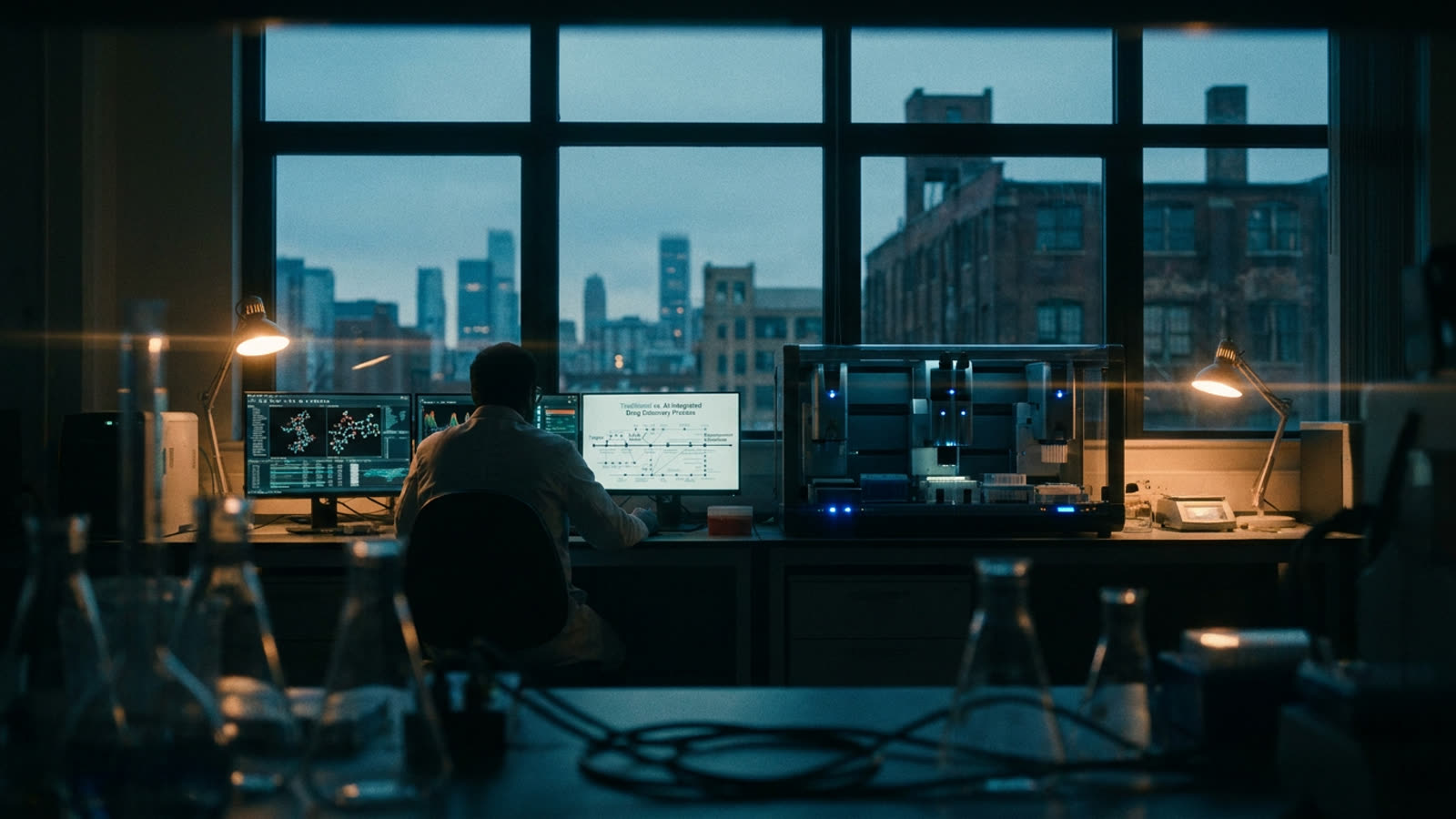
When biochemist Alex Zhavoronkov founded Insilico Medicine in 2014, the idea that artificial intelligence could design entirely new drug molecules from scratch seemed like science fiction. The conventional wisdom held that drug discovery required decades of intuition from seasoned chemists, not pattern recognition from silicon. Today, AI-designed drugs are entering human trials at unprecedented speed, and the pharmaceutical industry's century-old discovery paradigm is crumbling.
The end of molecular guesswork
Traditional drug discovery resembles expensive gambling. Pharmaceutical companies screen millions of compounds hoping to find one that binds to a disease target without causing havoc elsewhere. The process typically takes 10-15 years and costs over a billion dollars per approved drug. Most candidates fail. AI changes this equation by predicting molecular behavior before synthesis, designing compounds with specific properties rather than testing random chemicals. DeepMind's AlphaFold provided three-dimensional structures for nearly every human protein, giving AI systems precise targets. Generative models now propose novel molecular structures optimized for binding affinity, solubility, and manufacturability simultaneously.
From computational curiosity to clinical reality
The first AI-designed drugs are reaching human trials with remarkable efficiency. Insilico's INS018_055, targeting idiopathic pulmonary fibrosis, went from AI design to clinical trials in under 30 months. Exscientia brought an AI-designed cancer drug to trials in just 12 months. BenevolentAI's algorithms identified baricitinib as a COVID-19 treatment by analyzing molecular networks invisible to human researchers. These aren't incremental improvements on existing molecules but entirely novel compounds that traditional methods might never have discovered. The speed advantage compounds: while one traditional program inches forward, AI platforms can explore thousands of chemical spaces in parallel.
The new pharmaceutical economics
AI drug discovery upends pharma's business model. Startups with modest funding can now compete with giants by leveraging computational power instead of massive screening libraries. The cost of bringing a drug to Phase I trials has dropped by an order of magnitude in some therapeutic areas. This democratization attracts new players: tech companies, academic labs, even patient advocacy groups can participate in drug discovery. Traditional pharma companies face a choice between acquiring AI capabilities or watching their R&D departments become obsolete. The shift resembles what happened to film photography or physical media: not gradual evolution but sudden displacement.
Our take
The pharmaceutical industry's AI transformation is both overdue and underappreciated. While tech journalists obsess over chatbots and image generators, the quiet revolution in drug discovery will save more lives than any consumer AI application. The real test comes in Phase III trials, where AI-designed drugs must prove they work better than traditional molecules. Early results suggest they will. The companies clinging to traditional discovery methods are writing their own obituaries. Within a decade, asking a human chemist to design a drug molecule from scratch will seem as quaint as asking them to calculate molecular weights by hand.