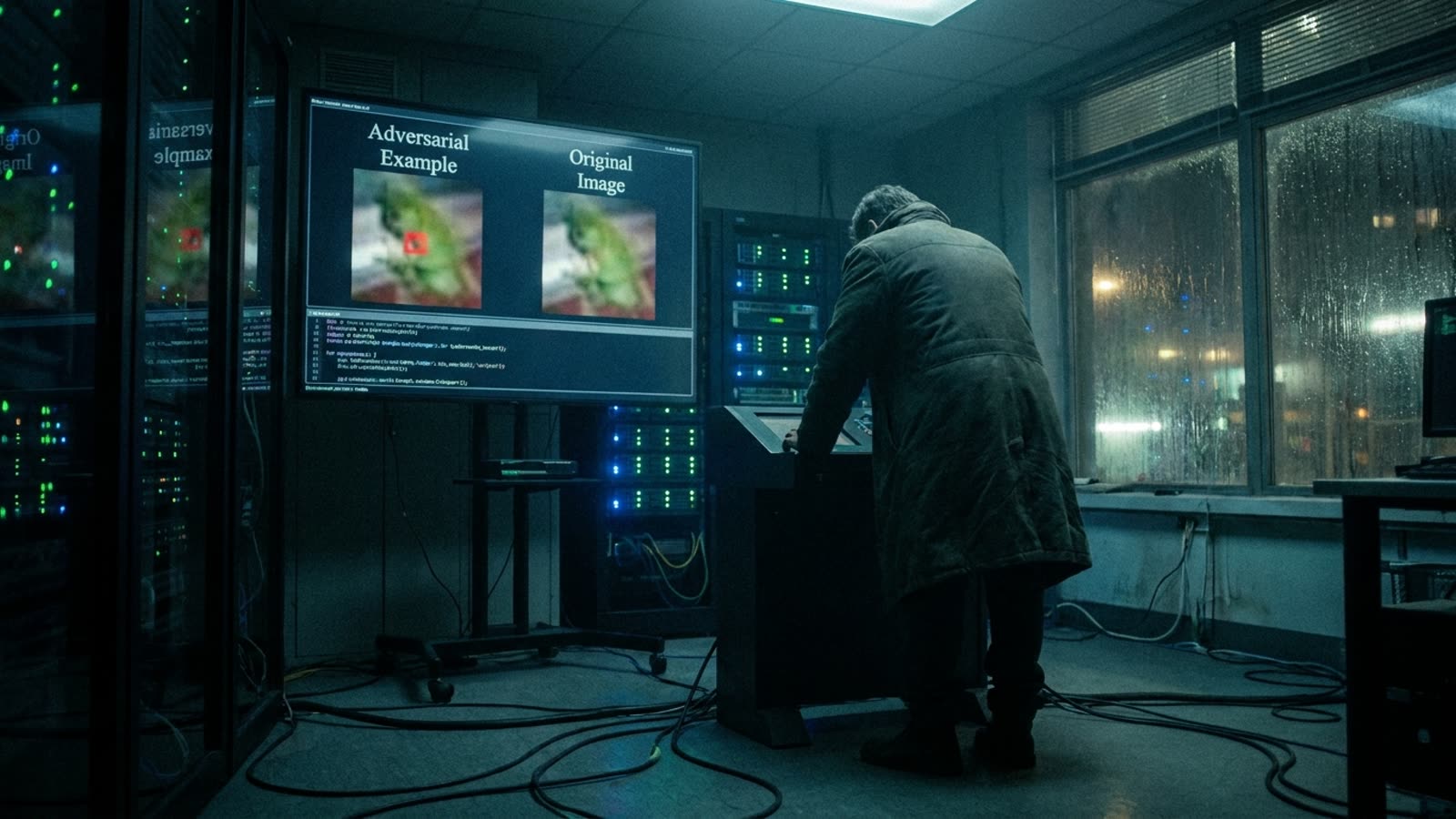
A modern image classifier can distinguish a Labrador from a Golden Retriever with superhuman accuracy, yet it can be fooled into seeing a toaster as a banana by changing a few pixels invisible to the human eye. This is not a bug to be patched but a window into what artificial intelligence actually does—and what it fundamentally cannot.
The systems we call "computer vision" do not see. They perform extraordinarily sophisticated statistical correlation, matching pixel patterns against distributions learned from millions of training examples. When a neural network "recognizes" a cat, it has identified that the arrangement of shapes, textures, and color gradients in an image falls within a probability space associated with images previously labeled "cat." It has no concept of whiskers, no understanding that cats are living creatures, no notion that they might be soft or warm or inclined to ignore you.
The adversarial problem
Researchers demonstrated years ago that adding carefully calculated noise to images—perturbations so subtle humans cannot perceive them—causes state-of-the-art classifiers to confidently misidentify objects. A panda becomes a gibbon. A stop sign becomes a speed limit sign. A rifle becomes a helicopter. These "adversarial examples" are not edge cases; they reveal that the statistical features networks rely upon bear no necessary relationship to the semantic features humans use.
The implications extend beyond academic curiosity. Autonomous vehicles use neural networks to identify pedestrians, cyclists, and obstacles. Medical imaging systems use them to flag potential tumors. Security systems use them to verify identities. Each application inherits the fundamental brittleness of pattern-matching divorced from understanding. A system trained to spot melanoma has no concept of skin, cancer, or death—only that certain pixel arrangements correlate with certain labels in its training data.
What humans do differently
Human vision is not merely higher-resolution pattern matching. We construct mental models of three-dimensional objects from two-dimensional retinal projections. We understand that a partially occluded cat is still a complete cat, that a cat in shadow is the same cat as a cat in sunlight, that a drawing of a cat and a photograph of a cat both represent the same kind of thing. We bring to vision an entire framework of physical intuition, causal reasoning, and categorical knowledge that neural networks simply lack.
This is why a child who has seen three cats can recognize the fourth, while a neural network requires millions of examples and still fails on adversarial inputs. The child is not memorizing pixel patterns; the child is building a concept of cat-ness that generalizes robustly because it is grounded in understanding rather than correlation.
Our take
None of this means computer vision is useless—it is extraordinarily useful, which is precisely why its limitations matter. The danger lies not in the technology but in the terminology. When we say a machine "sees" or "recognizes" or "understands," we import assumptions that do not apply. A calculator does not understand arithmetic; it manipulates symbols according to rules. A neural network does not see objects; it correlates patterns according to weights. The gap between correlation and comprehension is not a technical problem awaiting a clever solution. It is a categorical difference that should shape how we deploy these systems, what we trust them to do, and how we talk about what they are.