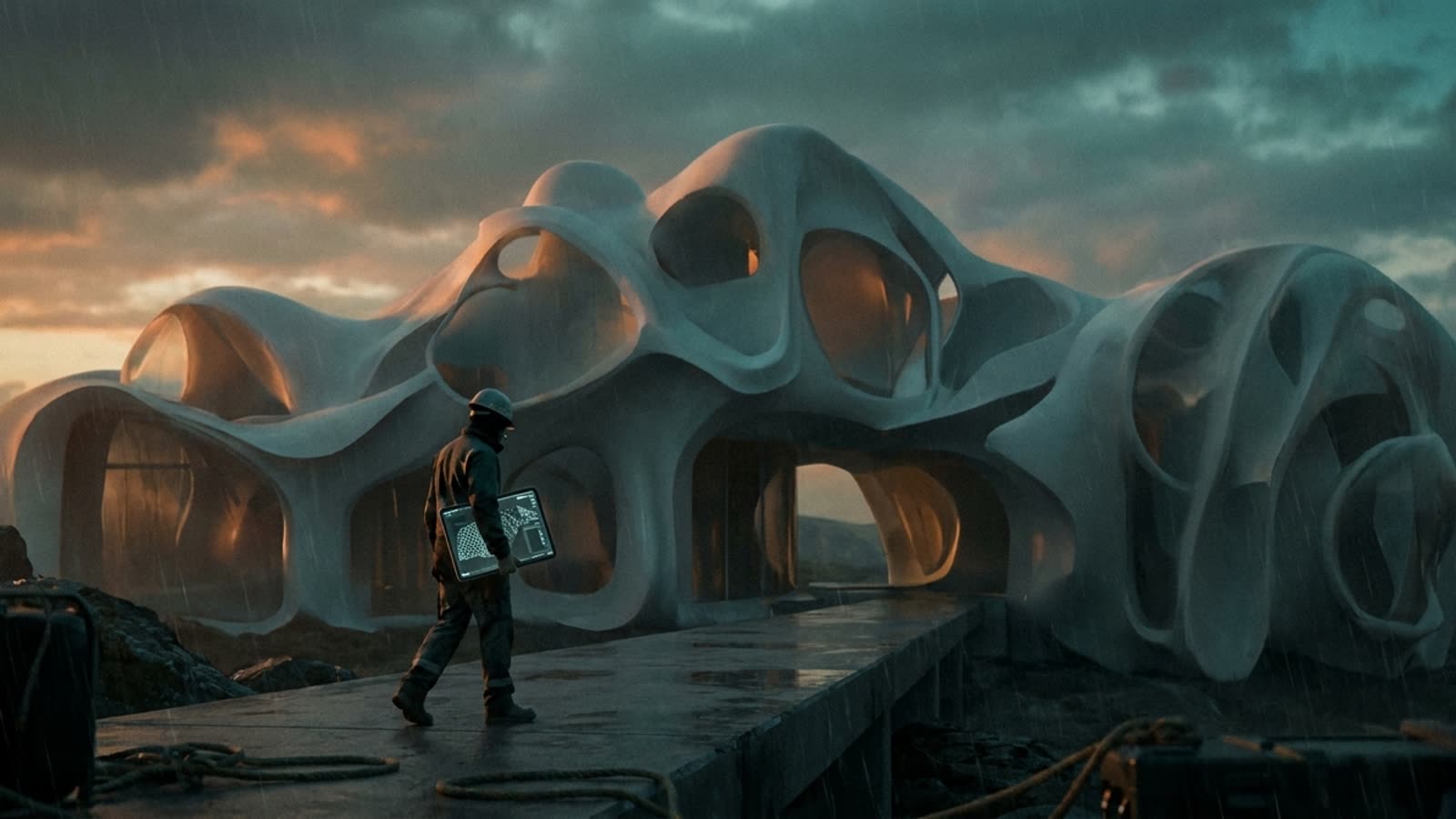
For most of the profession's history, architecture has been a discipline of singular vision. One mind, one hand, one drawing that becomes a building. The architect as auteur, from Brunelleschi to Gehry, has been the organizing myth of the field. Generative design software is quietly dismantling that myth—not by replacing architects, but by transforming them from authors into editors.
The shift is more profound than simple automation. When an architect using generative tools inputs site constraints, structural requirements, energy targets, and budget parameters, the software returns not one solution but hundreds or thousands of viable options, each optimized differently across competing variables. The architect's role becomes curatorial: selecting, refining, and ultimately taking responsibility for a design that emerged from algorithmic exploration rather than pure imagination.
The geometry of compromise
Buildings are fundamentally problems of competing demands. Natural light wars with thermal efficiency. Open floor plans conflict with structural economy. Accessibility requirements constrain aesthetic ambition. Traditional practice resolved these tensions through experience, intuition, and iteration—an architect might produce a dozen schemes before finding one that balanced the constraints acceptably.
Generative systems explore the solution space exhaustively, surfacing trade-offs that human designers might never have considered. A hospital wing might be configured to minimize nurse walking distances while maximizing patient access to daylight, with the software revealing that a counterintuitive L-shaped layout outperforms the obvious rectangular one. The insight emerges from computation, not creativity in the romantic sense.
What remains human
The anxiety within the profession is real but often misdirected. Generative tools excel at optimization within defined parameters; they cannot define what matters. The decision that a building should prioritize community gathering over private contemplation, or that a facade should evoke industrial heritage rather than sleek modernity—these remain irreducibly human judgments. The software proposes; the architect disposes.
More subtly, generative design has revealed how much of traditional architectural practice was actually unconscious optimization anyway. Experienced architects internalize rules of thumb about structural spans, circulation patterns, and material behavior. The software makes this tacit knowledge explicit and extends it beyond human cognitive limits. Whether this diminishes or enhances the profession depends on whether one believes architecture's value lies in the optimization itself or in the judgment that frames it.
The liability question
As generative tools produce increasingly complex geometries and novel structural solutions, a practical question looms: who bears responsibility when something fails? If an algorithm proposed a cantilevered form that a human architect approved and a structural engineer certified, the chain of accountability becomes murky. Professional licensing regimes built around individual competence struggle to accommodate hybrid human-machine design processes.
Some jurisdictions are beginning to require explicit documentation of AI involvement in permitted designs. The profession's insurers are watching closely, uncertain whether generative tools reduce risk through superior optimization or increase it through unfamiliar failure modes.
Our take
The architect-as-genius narrative was always somewhat fraudulent—buildings emerge from vast collaborative enterprises involving engineers, contractors, clients, and regulators. Generative design simply adds another collaborator, one that happens to be tireless and mathematically rigorous. The interesting question is not whether AI will replace architects but whether the profession can mature past its auteur mythology to embrace a more honest account of how buildings actually get made. The pencil was always just a tool. The new one simply draws faster.